
Summary
Škrip is a village in the interior of northern Brač, inland from Splitska. Its history links a prehistoric hillfort, Roman quarries, churches and fortified residences, while farming, stoneworking and connections with the coast shaped everyday life.
The village, the quarries and the harbour at Splitska tell a connected story of work, exchange and life on northern Brač.
Location and name
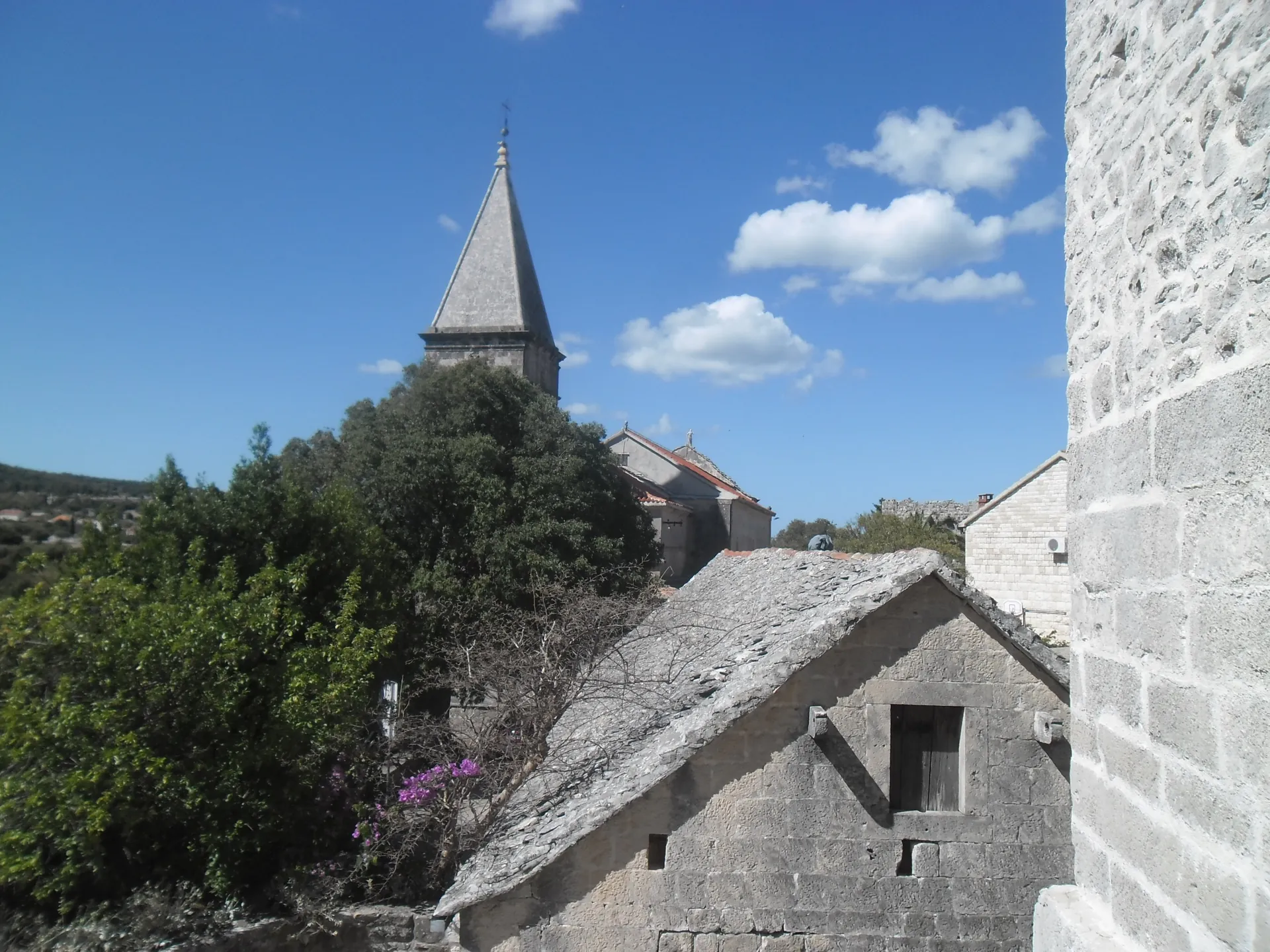
Škrip lies inland, above the coastal village of Splitska, and is administratively part of the City of Supetar. Hrvatska enciklopedija (the Croatian Encyclopedia) describes it as the oldest settlement on Brač. Its long history encompasses archaeologically documented periods of habitation, changes in land use and the later expansion of the village.
The name is associated with the Latin word scrupus, meaning sharp, large stones. Stone defines both the natural setting and the buildings of the village: from the massive blocks of its defensive walls to its houses, churches and nearby quarries.
From a prehistoric hillfort to an ancient settlement
Archaeological investigations by Aleksandra Faber and Mladen Nikolanci identified traces of a Bronze Age settlement and surviving fortifications from the Late Iron Age. The hillfort and Roman mausoleum in Škrip reveal these layers within the present-day village. The massive blocks of the defensive walls bear witness to the protection of the settlement, while ancient tombs and buildings reflect later changes to its centre.
The tradition of a Greek foundation is not supported by reliable evidence. Nor does the Roman mausoleum establish the identity of those buried there: its attribution to Diocletian’s family belongs to local tradition. Research into the settlement also points to its role as a refuge for coastal inhabitants in Late Antiquity.
Quarries, quarry workers and the harbour at Splitska
The Roman quarries above Splitska — Plate, Rasohe and Stražišće — form part of Škrip’s economic hinterland. Nenad Cambi interprets Škrip as a centre of imperial administration for quarrying. Stone was exported through Splitska and was also used to build Diocletian’s Palace. The history of the hilltop settlement is thus connected with work in the quarries and maritime transport to the mainland.
The relief of Hercules at Rasohe and the votive inscriptions also reveal the beliefs of the people engaged in this work. Hercules was venerated as the protector of quarry workers; in Cambi’s interpretation, the rock-cut sanctuary forms part of the quarries’ working and religious landscape.
The church known locally as crkva sv. Jadre also stands between Škrip and Splitska. It belongs to the area’s religious heritage of Late Antiquity. Its proximity to the quarries does not, in itself, confirm that it specifically served the quarrying community.
Churches and the changing centre of community life
The Church of the Holy Spirit (crkva sv. Duha), in today’s cemetery, is important for understanding the transition from Late Antiquity to the Middle Ages. Radoslav Bužančić dates its initial construction to the 7th century and its restoration to the Early Romanesque period. The surviving building preserves evidence of different phases in the life and renewal of the settlement.
The parish church of St Helena of the Cross (sv. Jelena Križarica) belongs to the village’s later centre, beside Kaštel Cerinić, a fortified residence. The present church was completed in 1816, and St Helena became its co-patron saint in 1823. Altarpieces by Jacopo Palma the Younger were transferred here from the older church. The tradition that Helena was born in Škrip is part of local memory, rather than an established biographical fact.
Fortified residences: defence and family standing
Kaštel Cerinić shows how housing, economic interests and defence were linked in the early modern period. According to Hrvatski biografski leksikon (the Croatian Biographical Lexicon), an inscription dated 1570 records the construction of Mihovil’s residence in Škrip, which Jakov completed in 1618. The same family also owned a residence in Splitska, demonstrating its presence in both settlements.
Radojković Tower was built in the 16th century above an ancient building. It is now part of Muzej otoka Brača (Museum of the Island of Brač). In this complex, remains of the ancient settlement, later defensive architecture and the museum occupy the same site.
Olives, vineyards and work in the old olive oil mill
The story of Muzej uja (Olive Oil Museum) begins with a working olive oil mill. Josip Krstulović’s family founded the mill in 1864. In the early 20th century, Kruno and Mandica Krstulović extended it and acquired a new press from Trieste. The mill operated until 1963; it was restored and opened as a museum in 2013.
The surviving mill, press and tools connect the olive groves with the daily work of processing, transporting and storing oil. Wine was also important to the village’s economic history: exports encouraged growth, while a market crisis and phylloxera contributed to emigration in the early 20th century.
Minjera: mining history beyond the village
Minjera mine, north of Škrip towards Splitska, reveals another branch of the local economy. Rock containing natural bitumen was mined here to obtain mineral pitch for further use. The mine’s operation is associated with the 18th and 19th centuries.
Minjera differs from the Roman quarries: it was worked for a raw material contained within the rock, rather than for building blocks. Underground passages, natural cave sections and the remains of mining activity reveal another way of using the same karst landscape. The mine is not a conventional walking attraction; permission and specialist accompaniment must be checked before entering the underground workings.
Schooling, emigration and the Chakavian voice
Škrip’s community history extends beyond its monuments. Primary schooling began in 1828 at the initiative of the parish priest. During the 20th century, emigration for work and education changed the village, while the closure of the school marked the decline in the number of children. The 2021 census recorded 157 inhabitants.
A festival of Chakavian poetry, held since 2009, is associated with Stjepan Pulišelić, the sociologist and Chakavian poet born in Škrip. Language and literature continue the story of belonging to the village alongside its architectural and economic heritage.
Muzej otoka Brača and the wider island story
Muzej otoka Brača was founded in 1979 within the Radojković Tower complex. Its collections connect Škrip with other parts of the island, including finds from Kopačina Cave near Donji Humac, as well as Roman reliefs, altars and inscriptions from the surrounding quarries.
The connection with Kopačina Cave concerns museum collections and research: the finds shed light on earlier life on Brač, but do not establish that the present-day settlement of Škrip originated in the Palaeolithic. Museum objects associated with agriculture, livestock keeping, seafaring and stoneworking help connect the surviving buildings with the lives of the people who used them.
Articles and stories about this place
Selected articles offering wider context and stories beyond the specialist literature.
Škrip ↗
A historical overview of the village, its families, economy and community life.
Read article ↗