
Summary
Klesarska škola in Pučišća is an educational institution connected with Brač's long tradition of quarrying and stoneworking. Its teaching preserves hand-carving techniques and passes them on to new generations of craftspeople.
Klesarska škola in Pučišća is an educational institution connected with Brač's long tradition of quarrying and stoneworking. Its teaching preserves hand-carving techniques and passes them on to new generations of craftspeople.
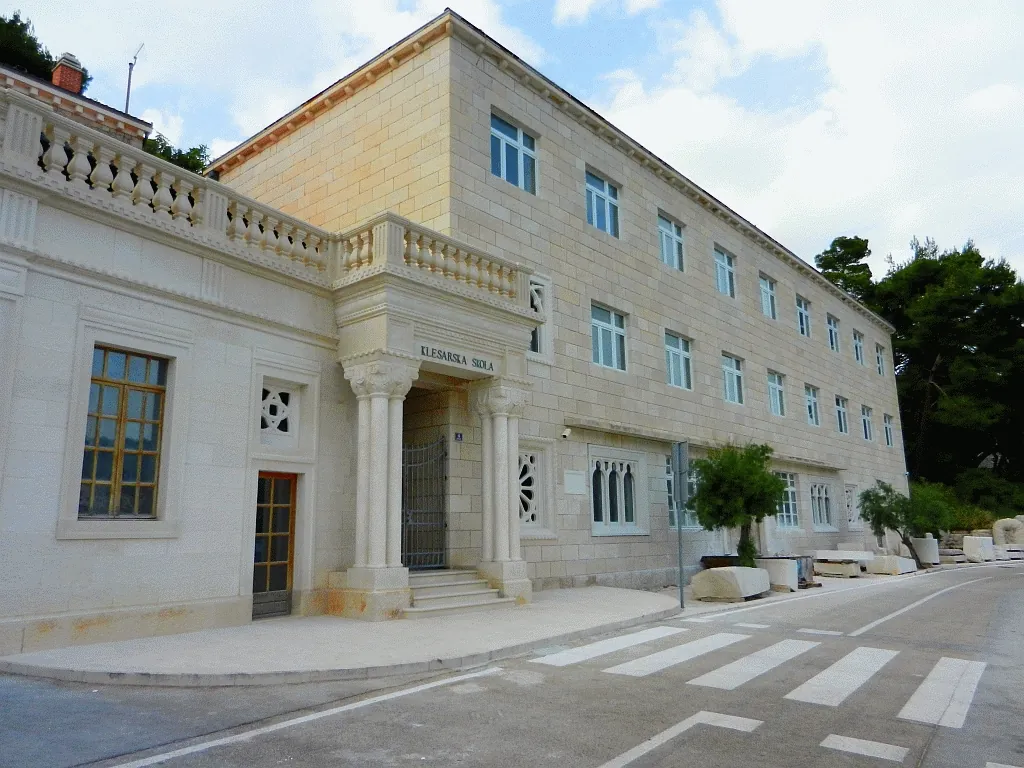
The school and Brač stone
The institution has operated since the beginning of the 20th century in a settlement closely connected with quarries and the stoneworking trades. The school's history and workshops show how local craft developed into systematic vocational education.
A distinctive feature of the teaching is working stone with traditional hand tools. Through practical exercises, students learn about the material, the sequence of carving and the precision required for architectural and decorative elements.
Organised stone-carving courses in Pučišća and Selca had been held since 1906 in cooperation with the Craft School in Split. In early 1909, the School for Advanced Stone Carving was founded under the direction of Emil Ruml, a stonemason from Czechia. The institution's development therefore has roots both in local workshops and in the vocational training system of the time.
The institution's development and school building
After the Second World War, teaching was linked to students' work in a stoneworking company. In 1956 an Industrial Stone-Masonry School was established, and the present school building was completed in 1958/59. The institution regained its independence under the name Klesarska škola in 1991.
Changes in names and educational programmes reflect the relationship between craft, industry and vocational training. The building visitors see today is therefore not from the time of the first courses, although the institution preserves a continuous educational tradition dating from the beginning of the 20th century.
A living tradition
The school is an active place of work and learning, not just a collection of old tools. Student work and participation in projects connect heritage with contemporary construction and monument conservation. The official school website provides information about its teaching, institution and activities.
Access and visiting
The school is on Obala Trifuna Bokanića in Pučišća. Arrange any visit to the workshops and agree a time with the school, especially during teaching hours. Working spaces and student work do not imply open access at all times.