
Summary
The Marinčević-Gligo family’s Kaštel is a fortified residential and farm complex on the coast at Bobovišća na Moru. Its defensive walls, houses and courtyard bear witness to the links between maritime trade, family estates and the protection of the harbour.
The Marinčević-Gligo family’s Kaštel is a fortified residential and farm complex on the coast at Bobovišća na Moru. Its defensive walls, houses and courtyard bear witness to the links between maritime trade, family estates and the protection of the harbour.
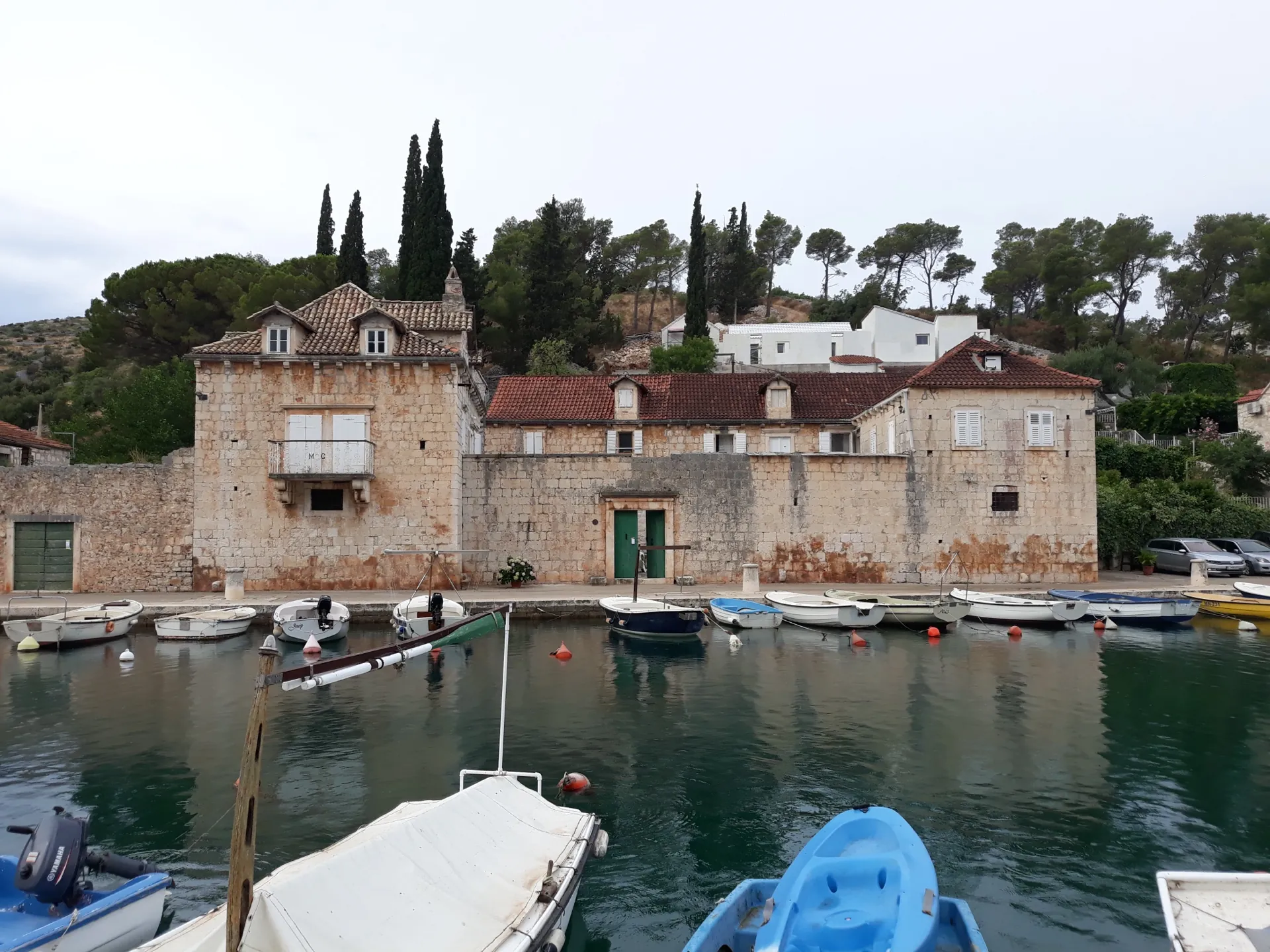
A fortified complex by the harbour
The Kaštel developed over several building phases. The Milna Tourist Board mentions it in a record from the late 16th century, while archival research by Nataša Bajić-Žarko and Hania Mladineo Mika associates most of its stately construction with the late 17th and 18th centuries. The oldest house, with defensive features, has not been precisely dated.
The Marinčević-Gligo family was involved in seafaring and the trade of wine, oil and grain. In addition to housing, the buildings were used to store goods, while the enclosed complex protected the harbour and the route inland. A 1781 property division agreement is an important source for its layout at that time.
Courtyard, houses and defensive wall
A tall defensive wall stands out on the seaward side. Beside it, a stone walkway on vaults is partly preserved, and loopholes and other defensive details can be seen on the buildings. The southern house belongs to the older core, while the eastern section shows the Baroque phase of the complex.
Over time, defensive use gave way to economic and country-house functions. The complex should therefore be seen as the result of gradual development, rather than a single construction in a precisely known year.
Access and visiting
The complex can be viewed from the coastal public space at Bobovišća na Moru. The inner courtyard and houses are not a public walkway; arrange any entry with the owners. Do not confuse this protected Kaštel with other Gligo family houses in upper Bobovišća.